World Book Day is celebrated in the UK and Ireland annually on the first Thursday in March (March 5), with a focus on promoting reading for pleasure. It is also celebrated on April 23 to promote reading, publishing, and copyright.
So, from papyrus scrolls to printed books to e-books, books have travelled a long journey & have shaped humanity through literature, facts, imagination & scientific temper. And yet, today we struggle to keep the reading habit alive amongst the masses. The overuse of social media & the shortening of attention spans have pushed books aside for many people, aside from avid readers. As the never-ending fight between technology advancement & protecting ancient wisdom continues, I would like to focus this blog hop on books written by women, as March 8th is also celebrated as International Women’s Day. Like every aspect, making a mark in writing for women has been tough, too.
Women navigated societal constraints, lack of education & even the fear of losing the right to live, while voicing out their opinions. Probably because of this there is no significant record of the earliest women who broke the rules of society & wrote! Their works were either suppressed, ignored, or even burnt!
There have been phases of resilience from women across the world to create their own space in the field of writing. The first literary, non-anonymous author who’s been found so far was a woman, a priestess named Enheduanna. She wrote narrative poems, some political and some religious, in the city of Ur, a Mesopotamian city in what’s now Iraq, around 2300 BCE. This claim is not free from doubts, but there remains a tiny hope that this could have been a possibility that a woman found with a clay tablet in the depiction of excavated remains was peobably the first woman author of the world.
Ban Zhao, a Chinese poet, writer, and historian born in 45 CE, was well known and influential in her time. Women dominated literature in Japan during the Heian period (794–1185 CE) , including Murasaki Shikibu, who wrote The Tale of Genji, considered to be the world’s first novel.
We do not even have any elaborate records of the first woman in Europe who wrote prose fiction. She is known as Marie de France because she wrote “Marie ai num, si sui de France” (Marie is my name, and I am from France). She was highly educated and multilingual. There were many notable writers before the famous Jane Austen who contributed massively to the field of writing, but their names were never recorded & many also wrote under a pseudonym of a man.
India was also no different, where women faced restraints to make their mark. traced
back to the ancient Sanskrit texts such as the Vedas, Upanishads, and the Mahabharata. Women such as Maitreyi and Gargi, who were part of the Vedic system, challenged traditional gender roles and advocated for equal rights. Rishi Lopamudra is credited with writing the Vishnudharmottara Purana (4th-5th century CE). A prominent figure in the history of Indian literature, she is
considered one of the earliest female authors to be known.
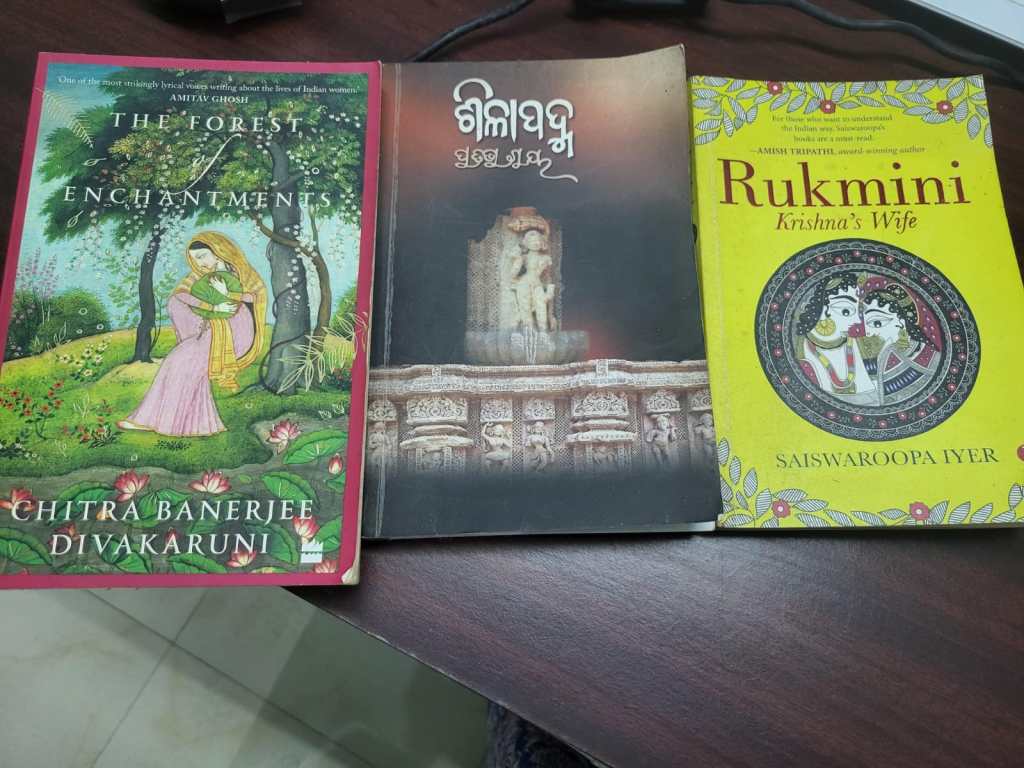
So, I , as a woman can only feel grateful that whatever little I write, or read, is because of such stalwarts who fought to be heard, to be read, and broke the glass ceiling of society, which was possible after many trials & tribulations. Hence, I have picked up three books written by female writers & would like to give a brief summary of each book to my readers.
1: The Forest of Enchantments by Chitra Banerjee Divakaruni: We all know about Sita in Ramayan, but every time it has been told from a male perspective. This book gave me goosebumps while reading, as it was the protagonist, Sita, narrating her fate in the book. Sita, through her pen, takes us back to the journey where one can actually visualize her life ( such is the power of storytelling), starting from the stage where she was a kid, till the moment she had to tragically leave her husband, Ram, due to unavoidable circumstances. I loved the climax and Sita’s response, when she boldly defies her husband’s biased viewpoint, perfectly summed up the book for me. She says:
“Because if I do what you demand, society will use my action forever after to judge other women. Even when they aren’t guilty, the burden of proving their innocence will fall on them. And society will say, Why not? Even Queen Sita went through it. I can’t do that to them.”
You can read a detailed review of the book here: The Forest of Enchantments
2: Shilapadma by Dr. Prativa Ray ( Odia): This is one of the famous books, a critically acclaimed Odia novel by Jnanpith award-winning author Dr. Pratibha Ray. Shilapadma literally translates as “stone lotus” (shila = stone, padma = lotus). The book showcases parallel narratives. One timeline is the reign of Shri Narasimha Deva, the king who had built the Sun temple ( The Konark temple ). It was the 13th century. And the other is the current timeline ( when the book was published in the 1980s). The book sheds light on the situations that had made the construction of this temple almost impossible, but the indomitable spirit of the craftsmen made it a reality. It brings forth the ephemeral nature of life and challenges the objectification of women’s figures on the temple walls.
3. Rukmini –Krishna’s wife by Saiswaroopa Iyer: This book presents Rukmini before its readers. Overshadowed by the fame of her husband, Lord Krishna, not many know about the life of Rukmini. Rukmini was fiesty and made bold choices in her own life. She vehemently denied her marriage to Shishupala and eloped with her beloved Krishna. She was his prime consort who took on the responsibility of her husband’s affairs and held the fort during her husband’s absence from Dwaraka. Rukmini shows that her life does not end with her marriage; she proves herself as the best partner for her husband, who intellectually handles every situation with grace, and at the end is viewed as a goddess just like her husband, Krishna!
So, in conclusion, I can only say that more & more writing needs to be encouraged from women writers & the world will always become a better place to survive if it becomes more inclusive! And cheers to the courage of the women writers who gave it their all and made it possible for people like me to experience the magic of reading & writing through their persistent struggles. And today, women in writing are making heads turn with their pen. They have proved that the pen is surely & will always be mightier than the sword!
And if this revolution is not the plot twist, then what is?
“This post is a part of ‘Plot Twist Blog Hop’ hosted by Manali Desai and Sukaina Majeed under #EveryConversationMatters blog hop series
Love,
Chinmayee
References:
- Wikipedia
- Britannica Website
- The Guardian Website
“This post is a part of ‘Plot Twist Blog Hop’ hosted by Manali Desai and Sukaina Majeed under #EveryConversationMatters blog hop series” and #EveryConversationMatters
Love,
Chinmayee
 Chinmayee's Creations
Women’s fate in history is always a touchy subject, whether we examine the literal arts or sciences. It is heartening to realise how slowly, but surely, we are taking the reins and shining in our own light again.Wonderful write up, Chinmayee.
LikeLiked by 1 person
Thanks a lot for reading & appreciating.
LikeLike
It’s good you brought these Indian female idols here. Sita, Rukmini, Draupati… there are many such heroines who deserve another perception.
LikeLike
I haven’t read any of the three titles or the women you mentioned in your short listicle here *runs and hides* but I know as a reader that reading many women authors is definitely one of my biggest motivators and inspirations for becoming an author myself 🙂
LikeLike
So true, when we encourage more women writers, we aren’t just diversifying a list of authors, we are enriching the global narrative with perspectives that have been sidelined for too long.
A more inclusive literary world creates a more empathetic society!
LikeLike
Out of the three books, I have read a review of The Forest of Enchantments. Encouraging more and more women writers is necessary. I think its happening now, but a lot more needs to be done.
LikeLike
Reading and supporting women authors is very important. Women create strong women characters, both in fiction and in reality.
LikeLike